
A calmer canvas for visual thinking
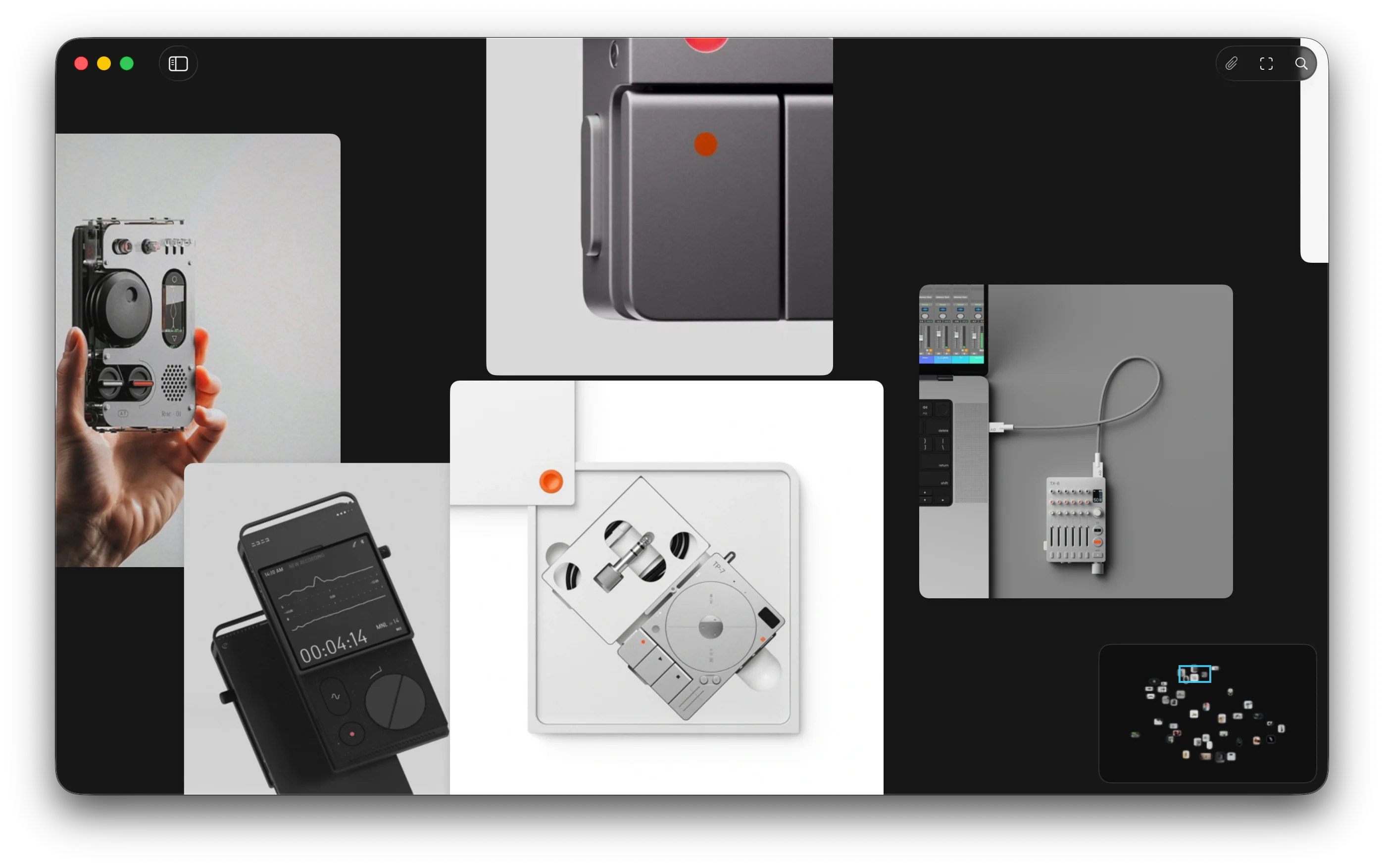
Reference is built around a simple idea: visual thinking needs room before it needs structure. A native canvas can hold images, notes, video, and half-formed directions without asking the work to become tidy too early.
Before an idea becomes a file
Creative work often starts in a state that is hard to name. A screenshot catches your eye. A product detail feels right. A still frame has the right amount of tension. A room, label, color, interface, or material starts to matter before you can explain why.
That early stage is fragile. If the tool immediately asks for folders, names, tags, and decisions, the reference can turn into administration before it has had time to become useful.
Reference tries to protect that first moment. You can drop something onto a board, move it beside another thing, add a note, and keep going. The canvas gives the material a place to land without forcing the project to make sense too soon.
Space is part of the thinking
A list can store references, but it does not show the distance between them. A folder can keep things together, but it does not show why they belong near each other. A board does something different: it lets relationships appear in space.
That is why the canvas matters. When images, quotes, videos, sticky notes, and sketches can sit beside each other, you start to see the shape of the project before you have the language for it. A cluster becomes a direction. A repeated detail becomes a rule. A note beside an image keeps the reason attached to the thing that sparked it.
The goal is not to make every board perfectly composed. The goal is to make the board useful while it is still messy.
Native, private, and close to the work
Reference is made for iPhone, iPad, and Mac because visual research often moves between devices. You might save something from the web on one device, arrange it on a larger Mac canvas later, then mark it up with Apple Pencil when the detail needs a quick circle, arrow, or note.
That workflow should feel like part of the Apple devices you already use, not like another public feed to maintain. Boards are private by default, sync through iCloud, and stay close to the work instead of becoming another profile or performance of taste.
Private matters because unfinished ideas need privacy. A board should be allowed to hold weak signals, contradictions, client-sensitive material, and references that only make sense to you.
Calm does not mean empty
The quietness of Reference is not about removing capability. It is about keeping the interface from competing with the material. Search, visual similarity, OCR, regions, mixed media, and Pencil annotations are there to help you return to what matters, but they should not make the board feel like a dashboard.
A creative tool earns trust when it respects both sides of the work: the quick instinct that saves a reference in the first place, and the slower return where that reference becomes part of a direction.
That is the kind of space Reference is trying to be. Not an endless feed. Not a social archive. Just a native place where visual material can stay close enough to become thought.