
Private Inspiration on Your Devices
Pinterest, Are.na, Savee, Cosmos, and other visual platforms all help people collect inspiration in different ways. Reference is for a quieter part of that workflow: a private, native place on iPhone, iPad, and Mac where your boards stay yours, sync through iCloud, and do not become material for tracking or resale.
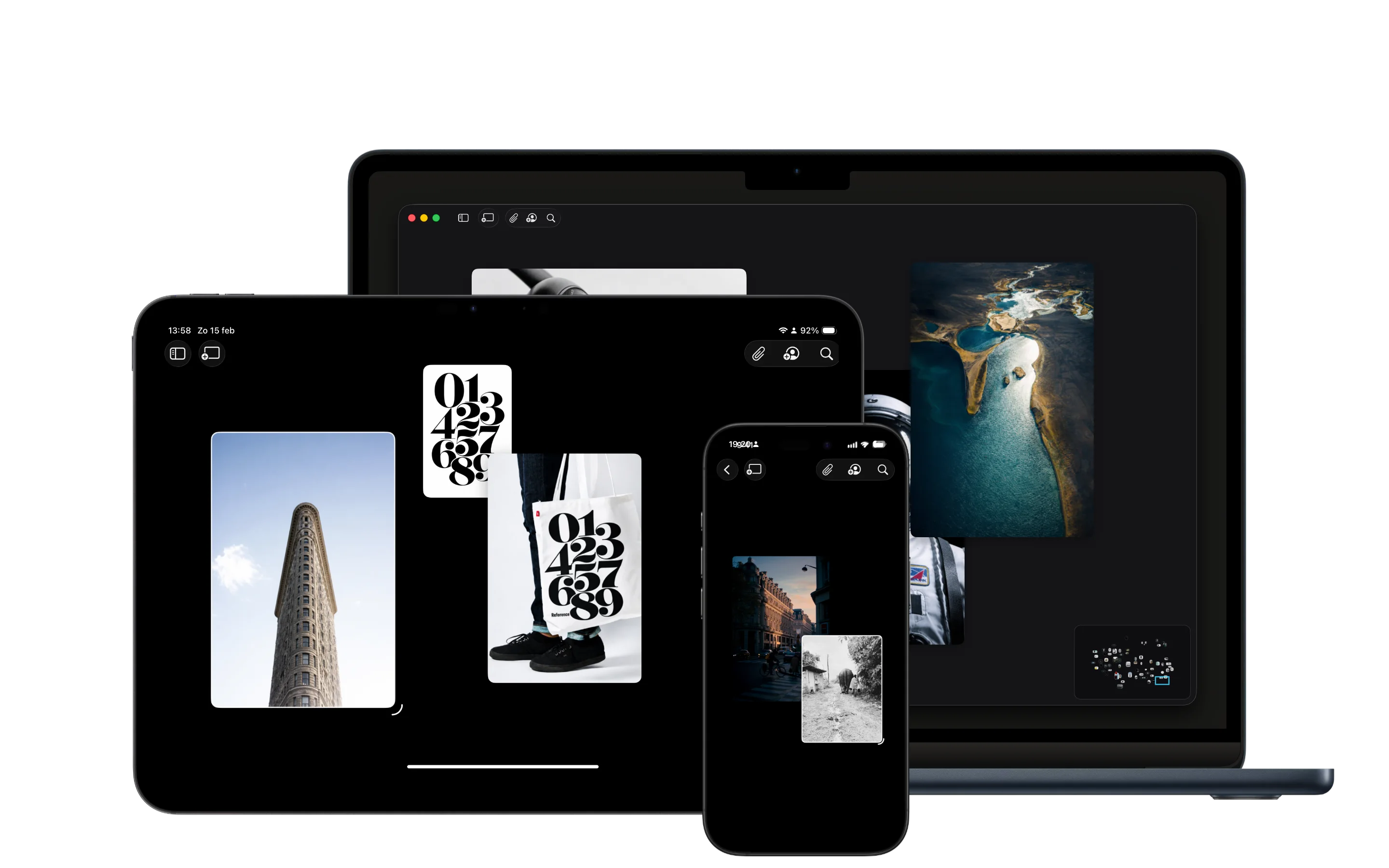
Different tools for different moments
There are more places than ever to find and save visual references. Pinterest is still the obvious one for broad discovery. Are.na has become a thoughtful space for connected research and public collections. Savee is fast and image-forward. Cosmos makes visual discovery feel polished and modern. There are moodboard tools, bookmark managers, social archives, and endless feeds built around taste.
They are useful because they each understand a real part of creative life. Sometimes you want breadth. Sometimes you want a public trail of ideas. Sometimes you want to browse quickly, follow a thread, or see what other people are noticing.
Reference is not built from the idea that those places are bad. It comes from a smaller observation: discovery and working with what you save do not always need to happen in the same mode.
Sometimes discovery should be open and outward-facing. Sometimes it should be curated, so you can start from better sources without wandering through everything at once. And sometimes, after you find something that catches your attention, the next step should be quieter. You want to keep it near a project, on the devices where you actually work, without turning every save into a public signal or another conversation to manage.
Reference is built around that assumption: inspiration should feel like yours first.
Pinterest, Are.na, Savee, Cosmos, and Reference
Pinterest is strongest when you want the internet to keep suggesting more. It is broad, familiar, and very good at discovery at scale. For many people, that is exactly what makes it useful. The tradeoff is that the feed is always nearby, so collecting can naturally stay connected to browsing.
Are.na is different. It is slower, more intentional, and better suited to research that benefits from connections between ideas. Channels can feel like living bibliographies. That public quality is part of its strength, especially for shared research and cultural context. Some ideas, though, need to stay unfinished without becoming part of a profile.
Savee is closer to a clean visual archive. It is good for browsing and saving images with less noise than larger social platforms. Cosmos has a similar appeal for people who want a more aesthetic, contemporary discovery layer. Both make inspiration feel easier to gather, and that is valuable. They still sit closer to discovery than to the private, project-level work that happens after something is saved.
Reference is not trying to replace those places as sources. It is trying to give the things you find a calmer native place to land.
That distinction matters. Discovery and collecting are related, but they are not the same thing. A discovery platform helps you find more. A private reference board on your own devices helps you understand what you have found, why it matters, and where it might belong.
Private by default changes the work
The homepage says it simply: Reference is a private moodboard app for iPhone, iPad, and Mac. Save inspiration, organize moodboards, find similar images, and keep creative references in sync across your own devices.
Native matters here too. Reference is not another tab you have to keep open or another public profile you have to maintain. It is a place for boards to live alongside the rest of your work, close to the screenshots, notes, images, videos, links, and fragments you are already collecting across iPhone, iPad, and Mac.
The privacy page puts it plainly: Reference does not track you, lock you in, or sell your data. Your inspiration stays private, and syncing happens through iCloud across your own Apple devices.
Private is not just a feature checkbox. It changes the emotional shape of the tool.
When a board is private, it can be messy. It can hold weak signals, half-formed directions, contradictory images, notes you might delete later, and references that only make sense to you. You do not have to perform taste. You do not have to name a collection before it deserves a name. You can save something simply because it feels relevant.
That is important because a lot of creative work begins before language catches up. You may not know why a room, color, product shot, poster, camera move, or bit of type feels useful yet. You only know that it does. A good board should let that early instinct stay intact long enough to become a direction.
Curated discovery, native collecting
Feeds are good at motion. They can be generous, surprising, and useful. They are not always the right environment for the slower part of thinking.
The new References page exists because finding better creative sources still matters. Good inspiration lives across studios, magazines, galleries, architecture journals, product sites, blogs, film platforms, and design archives. The goal is to build a curated list of places worth returning to, then make it easy to follow the work back to where it came from.
That requires some care. The list should respect the original publishers, artists, studios, and platforms that make the work available in the first place. Reference should be a doorway, not a replacement. It should help discovery feel calmer without pretending the work belongs anywhere other than its source.
So References can use feeds as a practical way to surface what is new, but that is different from making the whole product feel like a social feed. The point is to make discovery easier, then let you bring what matters into your own native space.
Once something is on a board, the rhythm should change. You should be able to sit with it. Compare it. Put it next to a note, a quote, a YouTube link, a video, or another image. Search it later by color, style, visible text, or the words you remember. Let it become part of a project instead of another item passing through a stream.
The canvas is where research turns into ideas
Saving inspiration is only the first step. The real work often starts when you begin arranging it: one image next to another, a material beside a color, a quote near a product shot, a video next to a still frame. A canvas gives those relationships room to appear.
That is why Reference is built around boards, not just folders. Curation is a way of thinking. When you place references in space, you start to notice patterns that were not obvious when everything was in a list. A cluster might reveal a palette. A repeated shape might point toward a direction. Two unrelated images might suddenly explain the feeling you were trying to find.
The infinite canvas matters because early ideas rarely arrive in a neat order. They spread out, overlap, contradict each other, and slowly become clearer. Reference gives that research a private surface where it can stay unfinished long enough to become useful.
Your taste should stay private
Creative references are personal. They reveal what you are looking at before you are ready to explain what you are making. They can point toward clients, pitches, campaigns, interiors, products, films, identities, and ideas that are still private for good reason.
That is why the difference between a private workspace and a public inspiration platform matters. It is not only about convenience. It is about choosing the right place for the right kind of attention.
There is an old internet tradeoff that is worth being honest about: when something is free, your attention often becomes part of the product. That does not make every free tool bad. It just means the incentives can be different. A service may need more engagement, more signals, more recommendations, or more reasons for you to keep coming back.
Reference Board is meant to stay on the quieter side of that line. It is just the app. A place to put your inspiration, not a network trying to own the relationship around it.
No public follower graph. No pressure to turn your research into content. No need for every board to talk back to a network. No algorithm deciding what matters. No tracking your private taste so it can be sold, modeled, or pushed back at you. Just a native place for the material that belongs to the project and to you.
Just a place to collect what sparks something, keep the context attached, and return to it when the project is ready.
A home for the things worth keeping
Pinterest, Are.na, Savee, Cosmos, and the rest can still be part of a creative workflow. Sometimes they are where discovery starts. Sometimes they are where a trail opens up. The difference is what happens next.
Reference is for the next part: the private board where a reference becomes useful because it sits beside other references, notes, clips, colors, and fragments of thought. The place where inspiration stops being content and starts becoming material you can work with on your own devices.
That is the goal. Not a better version of every other tool. Not a judgment on how anyone else collects. Just a quieter home for the part of inspiration that feels personal, unfinished, and worth keeping close. You should own your inspiration because it is yours, not something someone else gets to shape, package, or sell back to you.
Your inspiration, kept close.