
Moodboards Should Spark Ideas, Not Copy Them
Moodboards get a bad reputation when they are treated like shortcuts to a style. Used well, they are something more useful: a way to hold onto ideas, notice patterns, and move inspiration from one field into another without copying what it looks like.
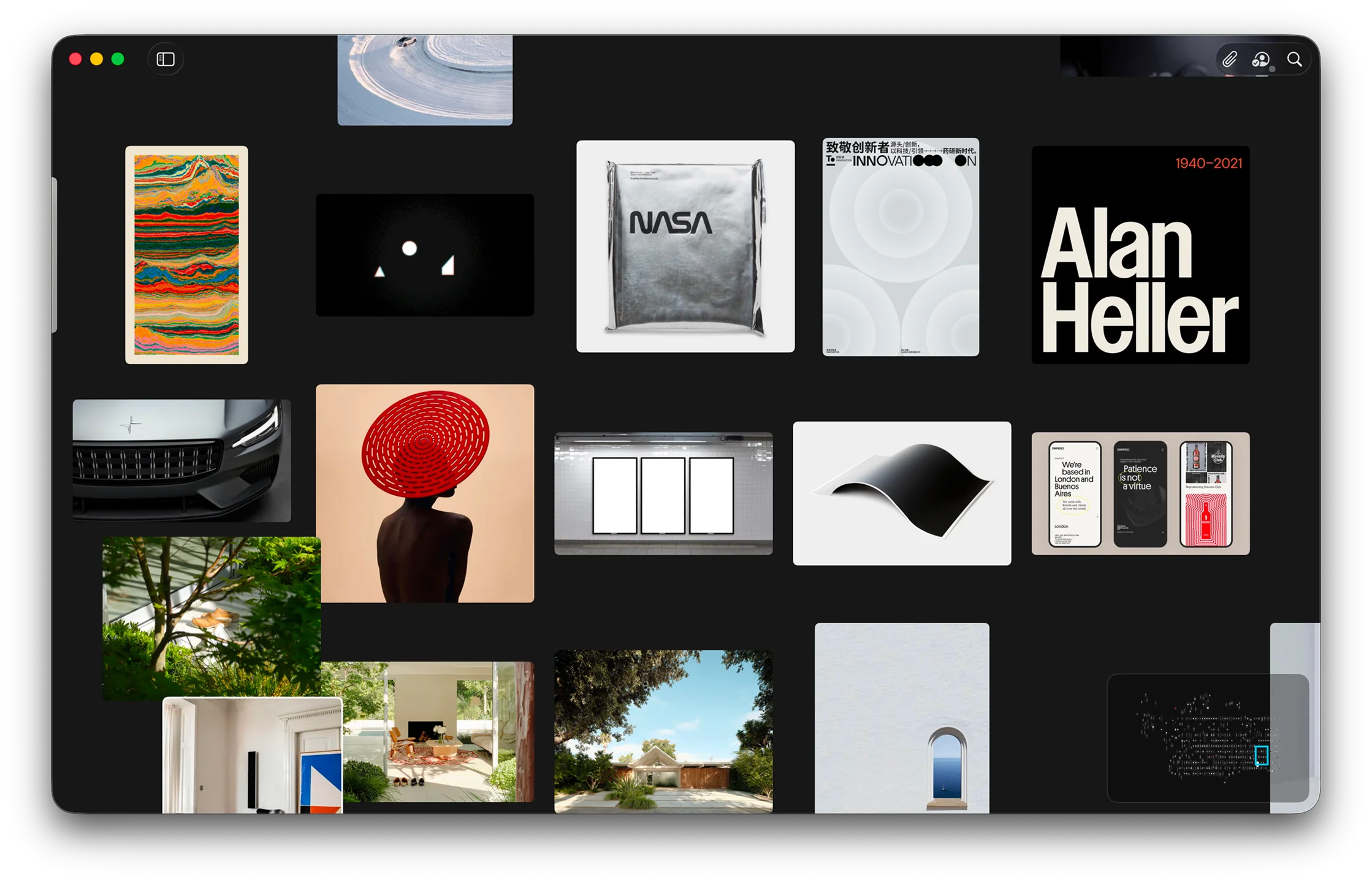
The problem is not the board
Moodboards get a bad reputation.
It is easy to see why. A board can become a folder full of nice-looking images. A shortcut. A way to borrow the surface of something instead of finding the reason behind it. If the board is only filled with work that already looks like the thing you want to make, the project can start drifting toward imitation before anyone notices.
Everything begins to look like everything else.
But that is not really a problem with moodboards. It is a problem with how they are used.
A good moodboard is not a shopping list for style. It is a thinking tool. It gives shape to a feeling before the feeling has language. It lets you hold onto a texture, a rhythm, a mechanism, a contrast, a behavior, or a small detail that seems important even if you cannot explain it yet.
That is the part worth protecting.
The board is not saying: make it look like this.
It is saying: there is an idea here.
References can come from anywhere
One of the easiest ways to misuse a moodboard is to make the references too obvious. A brand project becomes a board of other brand projects. A website becomes a board of other websites. An app becomes a board of other apps.
Sometimes that is useful. You need to understand the category. You need to know what people expect. You need to see the clichés clearly enough to avoid them.
But the more useful references often come from somewhere else.
A product designer might save a folding chair because the hinge explains an interaction. A brand designer might save a weathered wall because the texture says something about age, trust, or memory. A digital designer might save a subway map because it handles hierarchy better than a dozen interface screenshots. A motion designer might save a piece of fabric because the fold has the timing they are looking for.
None of those references need to resemble the final work.
That is the point.
The value is not in the appearance alone. It is in the thought underneath it. What is this doing? Why does it feel this way? What structure is holding it together? What would happen if that structure moved into a different medium?
A moodboard becomes more original when it stops collecting similar-looking things and starts collecting useful thinking.
Ideas are slippery
Ideas usually do not arrive as finished concepts. They show up as observations first.
A shadow on a wall. A label on an old machine. The way a tool opens. The density of a map. The mood of a film still. The calm of a room with almost nothing in it. A color that feels older than it is. A material that makes something technical feel human.
You save the reference because something in it understands the project before you do.
That is why moodboards are useful. They give those early observations somewhere to live. They keep the thought visible long enough for another thought to attach to it.
At the beginning of a project, this should feel loose. You collect across fields. You follow strange connections. You let the board become a temporary place for the things that might matter.
Later, the board should get more selective. You remove what is only decorative. You keep what supports the concept. You start asking whether each reference is carrying an idea or just filling space.
Near the end, the board can do something different again. It can help a team understand a direction without flattening the work into one rigid style. It can make an abstract idea easier to discuss. It can give clients, collaborators, or stakeholders something to respond to before the final work exists.
In that sense, a moodboard is not only about inspiration. It is also about communication.
The danger is fixation
The real danger is not reference. The real danger is fixation.
Examples can open a door, but they can also make the room feel smaller. The more directly a reference resembles the thing you are designing, the easier it is to stay too close to it. You start borrowing the layout, the color, the type, the composition, the gesture. Not because you meant to copy, but because the example quietly became the default answer.
That does not mean the answer is to avoid references.
It means the answer is to use them with more distance.
A useful moodboard should keep asking questions:
What is the idea behind this image?
Is it about shape, material, behavior, mood, structure, contrast, movement, or memory?
What can I learn from it without copying how it looks?
Can I find the same idea in a completely different field?
That last question matters most. Original work often comes from moving an idea sideways. Something noticed in architecture becomes useful for interface design. A pattern from nature changes the way a product opens. A film scene helps explain pacing in a presentation. A manufacturing detail becomes the basis for an identity system.
The reference did not provide the answer.
It provided a way of thinking.
Collect the thought, not the style
A board full of other brand identities might help you make a brand identity that looks like other brand identities.
A board with architecture, film stills, product mechanisms, old maps, fabric, signage, tools, rituals, and natural patterns might help you find something less expected. It gives you more ways in. It makes the project harder to reduce to a trend. It reminds you that visual work is connected to the rest of the world, not just to other visual work.
That is where moodboards become powerful.
Not when they collect taste.
Not when they prove that a style is popular.
Not when they make the work easier to copy.
They become powerful when they help you remember what you were actually noticing.
A moodboard is not good or bad by itself. It is a tool. Used poorly, it can make work generic. Used well, it can help you see what you are really trying to say.
And that is the point.
Not to copy the style.
To remember the idea.